
 zappi
zappi eddi
eddi eddi+
eddi+ libbi
libbi harvi
harvi Extras
 EV Charging
 Manage Your Energy
 Maximize Your Energy
 Track Your Energy Usage
 Find an installer
 Commercial Charging Station
 Connect Zappi to a management platform

Read more
The media frequently discusses the sustainability aspect of electric cars. Are electric cars sustainable, or are they actually harmful to the environment? In this article, we explain what makes electric cars sustainable and how they impact the environment.
1. Significantly lower CO2 emissions
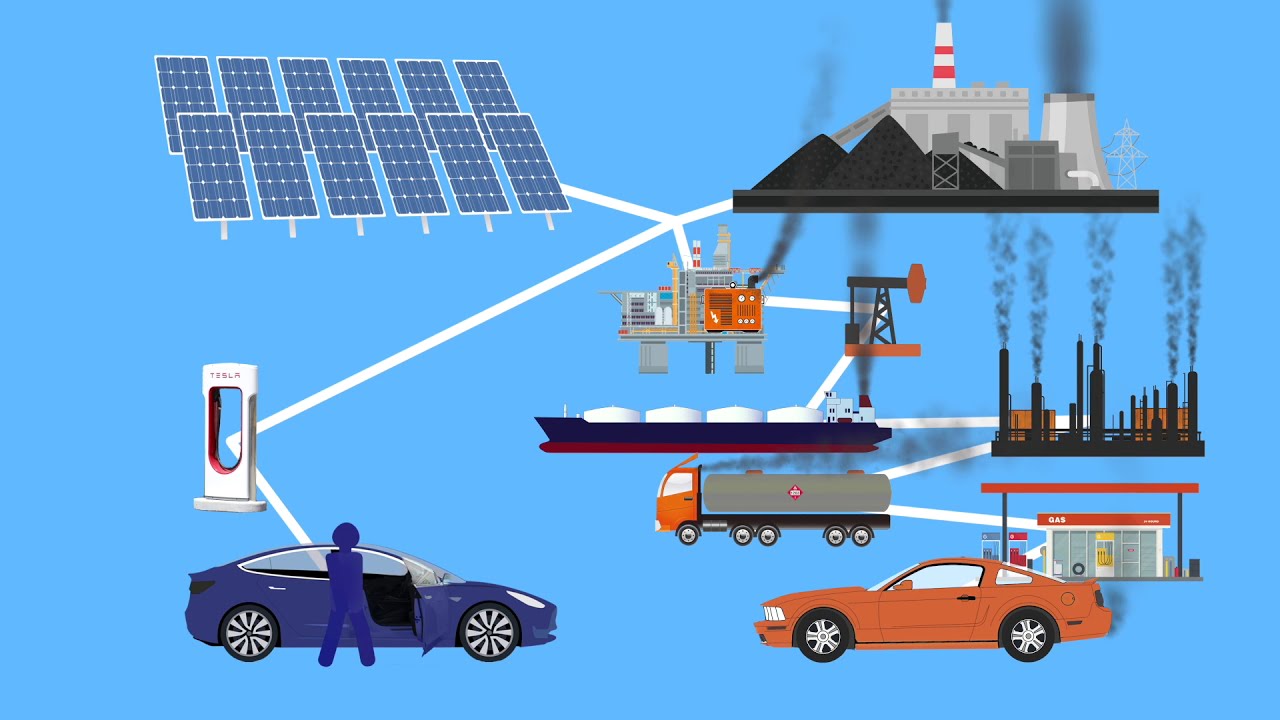
One important reason why electric cars are sustainable is their low CO2 emissions. Over their entire lifecycle, electric cars emit, on average, 40 percent less CO2 than gasoline-powered cars. Environment First calculated that a mid-range electric car emits about 32,300 kilograms of CO2, while a comparable gasoline-powered car emits about 53,100 kilograms of CO2. This calculation took into account the production of the car and the battery, as well as 220,000 kilometers of driving. In addition, they took into account the mix of “gray” and “green” electricity coming from the outlet. This last point implies that a positive change is on the horizon. CO2 is emitted during the production of “gray” electricity at power plants, but this is not the case with “green” electricity (during production). Do you charge your electric car with your own green energy? Then your CO2 emissions will be even lower.
With our smart EV charger zappi you can easily use your own green energy at home to power your Charging an electric car affordably and in an environmentally friendly way.
2. Beneficial for air quality
An electric car is better for air quality, especially in cities. That’s because it doesn’t emit particulate matter or nitrogen oxides from the exhaust while driving. Particulate matter and nitrogen oxides are not only harmful to our health but also to the environment. This is a particularly positive benefit of electric driving in cities, where air quality is often poor.
There is, however, one small caveat to mention: Just like a gasoline-powered car, an electric car does cause wear and tear on the road surface and disperses dust across the road. Contrary to what some people think, however, the wear and tear is no greater with an electric car than with a gasoline-powered car, despite the electric car’s heavier weight.
3. Electric Cars Are Sustainable Despite the Battery
A common argument is that electric cars aren’t sustainable because of battery production. It’s true that producing the battery requires a lot of energy. However, when you factor in the battery production, the emissions from an electric car are still lower than those from a gas-powered car. For every kilometer you drive, an electric car uses less energy than a gas-powered car. Electric driving is much more efficient, and that makes electric cars sustainable.
But what about the raw materials needed for the battery? If we take those into account, can an electric car still be called sustainable? Among other things, lithium, graphite, and cobalt are used to produce a battery. Lithium and graphite come from countries that are reasonably developed. Cobalt, however, does not. It is often still extracted from illegal mines in the Congo. It is dangerous work and also prohibited by law. Yet it continues to happen. Why? Because, according to human rights organizations such as Amnesty International, closing the mines would have even more negative consequences. However, organizations are calling for improved working conditions and for the use of as little cobalt as possible in future batteries. Batteries manufactured today already contain three times less cobalt than they did five years ago.
Is the extraction of raw materials for an electric car’s battery sustainable? No, often not—and on top of that, it’s dangerous work. Can we then say that an electric car has a negative impact on the environment? No, not that either. Why? Because the components of a battery can be recycled, unlike the fossil fuels used in, for example, a gasoline-powered car.
If a battery is no longer sufficient for an electric car, it can be given a second life as a storage device for solar or wind energy. If that’s no longer possible? Then they are recycled, and raw materials such as aluminum, copper, cobalt, and—increasingly—lithium are reused. In this way, the environmental impact of an electric car’s battery is also minimized.