
 zappi
zappi eddi
eddi eddi+
eddi+ libbi
libbi harvi
harvi Extras
 EV Charging
 Manage Your Energy
 Maximize Your Energy
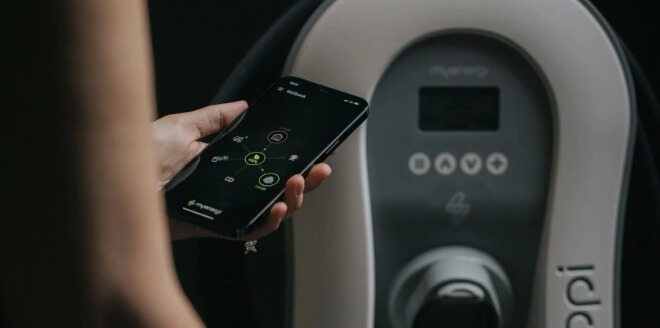 Track Your Energy Usage
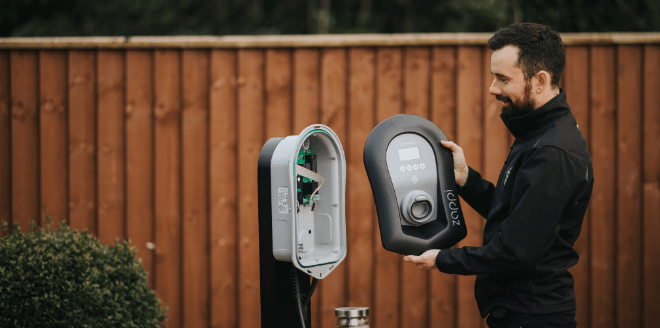 Find an installer
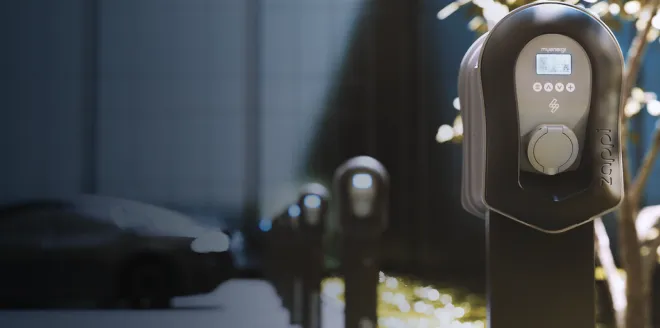 Commercial Charging Station
 Connect Zappi to a management platform

Read more
When we talk about electric cars, the term “range” often comes up. But what exactly is it? And why isn’t the range always the same? We’d be happy to tell you more about it.
What is a range?
The distance you can drive in an electric car on a full charge is called the driving range. It is also referred to as “range.” It is comparable to the distance a gasoline-powered car can travel on a single full tank of gas.
For mid-range electric cars, the average driving range is 310 kilometers. By comparison, a mid-range gasoline-powered car typically has a 45-liter fuel tank, which allows you to drive approximately 630 kilometers.
Why isn't the range always the same?
The battery’s power helps determine the driving range. Electric cars with a battery that has a higher power rating will be able to travel a greater distance. In addition, the battery’s capacity may decrease as it ages.
Just as with gasoline-powered cars, your car’s range also depends on fuel consumption and your driving style. Weather conditions can also play a role. In colder temperatures, your driving range is reduced.
Battery Capacity
Your battery’s capacity determines how much electricity you can store and is determined by the battery’s size. In small cars, there often isn’t much room for the battery, so it can be smaller. As a result, large cars often have a longer range than smaller cars.
However, new technologies are constantly being developed, so it will likely be possible in the future to store more energy in smaller batteries. As a result, the range of small electric cars will increase in the future.
Fuel Consumption While Driving
For gasoline-powered cars, fuel consumption is expressed in terms of the number of liters of fuel used per 100 kilometers. Because an electric car uses electricity, its consumption is expressed in terms of the number of kilowatt-hours of electricity used per 100 kilometers. Just as with diesel and gasoline-powered cars, the larger the electric car, the higher its consumption will be.
How the Weather Affects Your Range
Electric car batteries perform best at temperatures between 15 and 25 degrees Celsius. At higher temperatures, the battery’s capacity decreases. The battery can heat up from the sun, but also from fast charging. It is therefore important to cool the battery when using a fast charger.
However, the battery isn’t a fan of low temperatures either. It produces less energy in these conditions, which reduces your driving range. This can sometimes cut your range by as much as 30 kilometers. It’s especially important to keep this in mind when driving long distances in cold weather, such as when going on a winter sports trip.
How can I get the most out of my battery?
With a few tips, you can increase your range. For example:
- Drive 100 km/h on the highway instead of 120 km/h. By driving more smoothly, your battery will drain more slowly.
- Drive at a steady speed as much as possible and let the car coast to slow down.
- The air conditioning and heating in your electric car use a lot of energy. This reduces your driving range.
- Don't overload your car. If you don't need your roof box or bike rack, it's a good idea to leave them at home. That way, you'll experience less air resistance, and your car won't have to work as hard.
- Check your tire pressure regularly. It's best to inflate your tires every two months. Properly inflated tires are not only safer, but they also use less energy and extend the life of the tire.
Bonus tip: Always bring a charging card with you. If the battery runs out a little faster than you expected while driving, you can recharge it along the way.
[mwai_chatbot_v2 id="default"]