zappi GLO
 zappi
 eddi
 eddi+
 libbi
 harvi
 View all our products

Read more
Changes to planning rules and new government support are making cross-pavement EV charging easier to access. Alongside safe cable routing, installers need to consider another question: what else can someone touch while touching the connected vehicle? The answer matters on conventional driveways as well as at the kerb.
Lee Sutton, co-founder and Chief Innovation Officer at myenergi, explains what installers should check on site and how zapsafe™ helps.
Cross-pavement charging is becoming easier
From 21 October 2026, changes to permitted development rights in England removed the normal requirement for a separate planning application for qualifying cross-pavement EV charging installations.
Financial support is also available through the Electric Vehicle Chargepoint Grant for Households with On-Street Parking. It covers 75% of eligible chargepoint purchase and installation costs, capped at £500, subject to scheme eligibility and conditions, including installation of a cross-pavement charging solution alongside the chargepoint. Read the official government grant guidance.
The planning change does not, however, give homeowners permission to simply cut a channel into the pavement. The new permitted development right applies to qualifying installations, while highway authority authorisation and other permissions can still be required. See the government cross-pavement charging guidance.
Assess the vehicle’s surroundings, not just the chargepoint
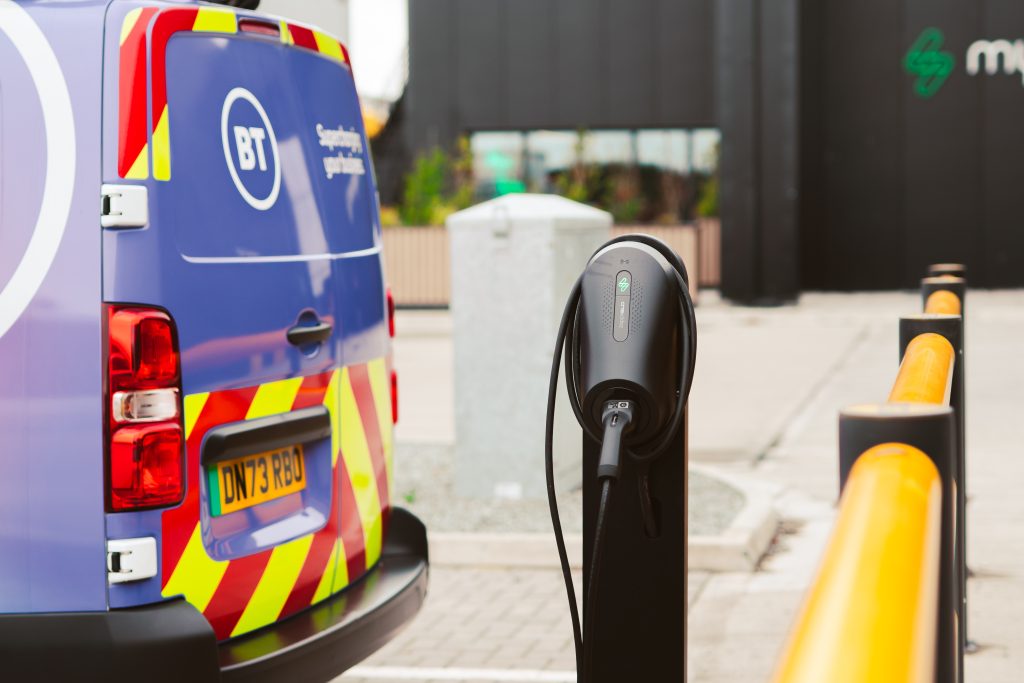
In a cross-pavement installation, the chargepoint may be connected to the customer’s domestic installation while the charging lead runs through an approved pavement channel to an EV at the kerb. The vehicle could be within reach of a lamp column, powered street furniture or another EV connected to a different installation.
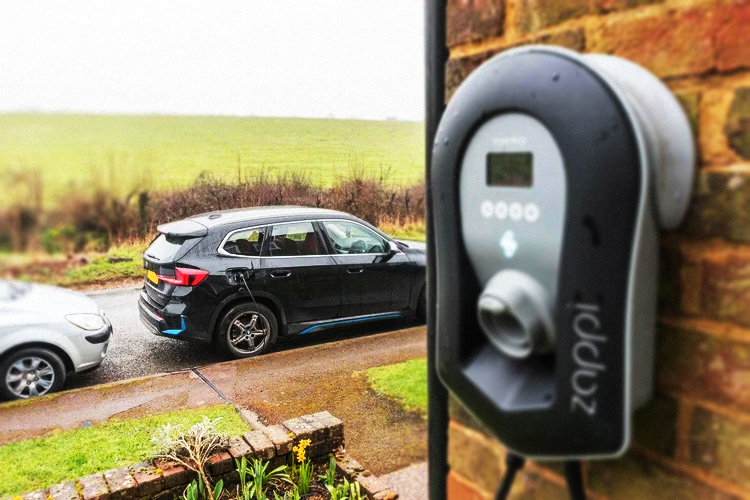
The same situation can arise on neighbouring driveways where two connected vehicles are parked within touching distance, or where a driveway borders electrically supplied street furniture. Two conductive parts can be close together and still be on different earthing arrangements.
Could someone touching the connected EV simultaneously touch another conductive part that could be at a different earth potential?
If the answer is yes, there’s a potential simultaneous-contact issue.
What does the IET guidance say?
The current IET Code of Practice for Electric Vehicle Charging Equipment Installation, 5th Edition specifically revised its simultaneous-contact assessment to accommodate installations involving a mix of earthing arrangements. The Code covers domestic, commercial and on-street installations.
The fifth edition was written to align with BS 7671:2018+A2:2022, so its EV guidance should be read alongside the current BS 7671:2018+A4:2026.
Physical separation is one way to address simultaneous contact: if conductive items connected to different earthing arrangements cannot be touched at the same time, that risk is removed by design. However, separation may be difficult to maintain where parking positions vary, or nearby equipment lies outside the installer’s control.
Then there’s the open-PEN problem
Simultaneous contact is a separate issue from the familiar open-PEN risk on PME supplies, and installers need to assess both.
Regulation 722.411.4.1 of BS 7671:2018+A4:2026 still sets the protective measures needed before a PME earthing facility can be used for a chargepoint that is outside, or likely to charge a vehicle parked outside.
If the network PEN conductor is lost, exposed conductive parts connected to the installation’s protective earth can rise significantly above true earth potential. A connected EV can then present a large conductive surface outdoors at an elevated potential while the person touching it is standing on the ground. Open-PEN protection is designed to deal with this risk.
Why voltage alone doesn’t necessarily tell the complete story
Supply-voltage monitoring is one approach to open-PEN protection: a line-to-neutral voltage outside defined limits can indicate a condition requiring disconnection. However, a normal line-to-neutral reading does not necessarily establish that the charging installation’s protective conductor and another earthing system are at the same potential.
How zapsafe™ works differently
myenergi’s zappi includes zapsafe™, which monitors protective-conductor current as well as supply voltage as part of its PEN-fault protection functionality. So its protection doesn’t rely on voltage monitoring alone.
myenergi’s zappi PEN Fault Protection Decla (DC-00052, available on the Document Downloads page) specifies the following protective-conductor-current operating characteristics:
| Protective conductor current | Maximum break time |
|---|---|
| 21 mA | 0.3 seconds |
| 51 mA | 0.15 seconds |
| 241 mA | 0.04 seconds |
If a threshold is exceeded, zappi disconnects the live and protective-earth conductors from the vehicle.
myenergi’s declaration states that this provides protection against electric shock during contact with conductors at different earth potentials. The declaration also identifies the charger as suitable for both TN and TT systems. Installers should apply these within the scope of the declaration and myenergi’s installation instructions.
zapsafe™ also monitors supply voltage. The declaration specifies that if the supply moves outside 230 V ±12%, the vehicle is electrically disconnected from all live and protective conductors.
What should installers look for?
During the site survey, identify the connected vehicle’s possible parking positions and check for accessible conductive items nearby, including:
- neighbouring EVs and chargepoints
- lamp columns
- powered street furniture
- electrical cabinets or enclosures
- conductive equipment associated with another property
- other potentially accessible conductive parts associated with different earthing arrangements
Where any of these are present, the installation assessment should show how the simultaneous-contact risk is handled, either through separation or a suitable protective measure.
The takeaway
Every zappi comes with zapsafe™ built in. Combining protective-conductor-current monitoring with supply-voltage monitoring, it provides the simultaneous-contact protection described in myenergi’s declaration, not just voltage-based open-PEN detection.